
Joseph Middeleer: A Demoniac
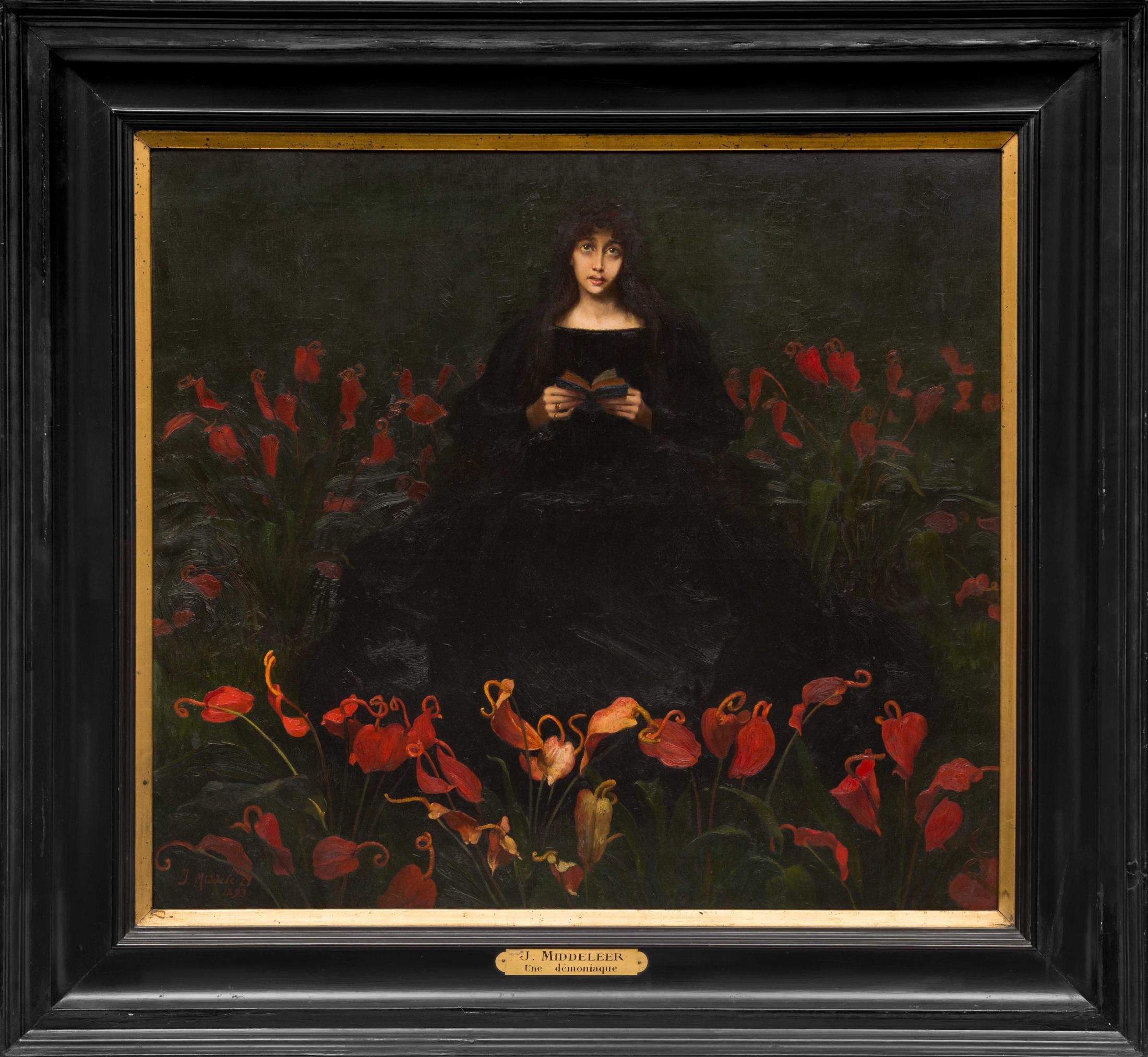
Painted in 1893, A Demoniac is one of the major works of Belgian Symbolism, in which Middeleer explores the ambiguity of the feminine figure. In a field of red anthuriums, a woman dressed in black pauses her reading and looks up, her face softly illuminated. Everything appears peaceful, almost innocent, yet the title introduces a deeper layer of meaning: nothing in the scene explains the unease it evokes. The restricted colour palette (black, red, and touches of light) suggests an inner drama, a form of spiritual alchemy moving from darkness toward revelation. A “demoniac” here is not an evil being, but a liminal presence, suspended between temptation, awakening, and transfiguration.
This ambivalence resonates directly with the world of The Flowers of Evil, which Middeleer seems to interpret almost literally. Baudelaire sees the woman as both a muse and a threat, ideal and fatal, a source of both elevation and decline. In The Vampire, the feminine figure captures and consumes; in Contemplation, she opens an inner space for the poet, where tenderness mingles with disquiet. Middeleer translates this duality into imagery: the young woman is not frightening, yet she unsettles gently, as if embodying the shadowed, desiring side of the self. She is the enigma of disturbance, a “flower of evil” revealing what the viewer carries within.
Exhibited at the Salon Voorwaarts, then at the Rose-Croix, and finally at the Salon Idéaliste, the painting belongs to a spiritual aesthetic in which light does not dispel mystery but rather intensifies it.
Joseph Middeleer (1865-1939), A Demoniac (1893), 89x100cm, oil on canvas, private collection, Bruges.
Work on display in our exhibition Echoes of Dreams until April 19, 2026.