
Fernand Khnopff: After Flaubert. The temptation of Saint Anthony
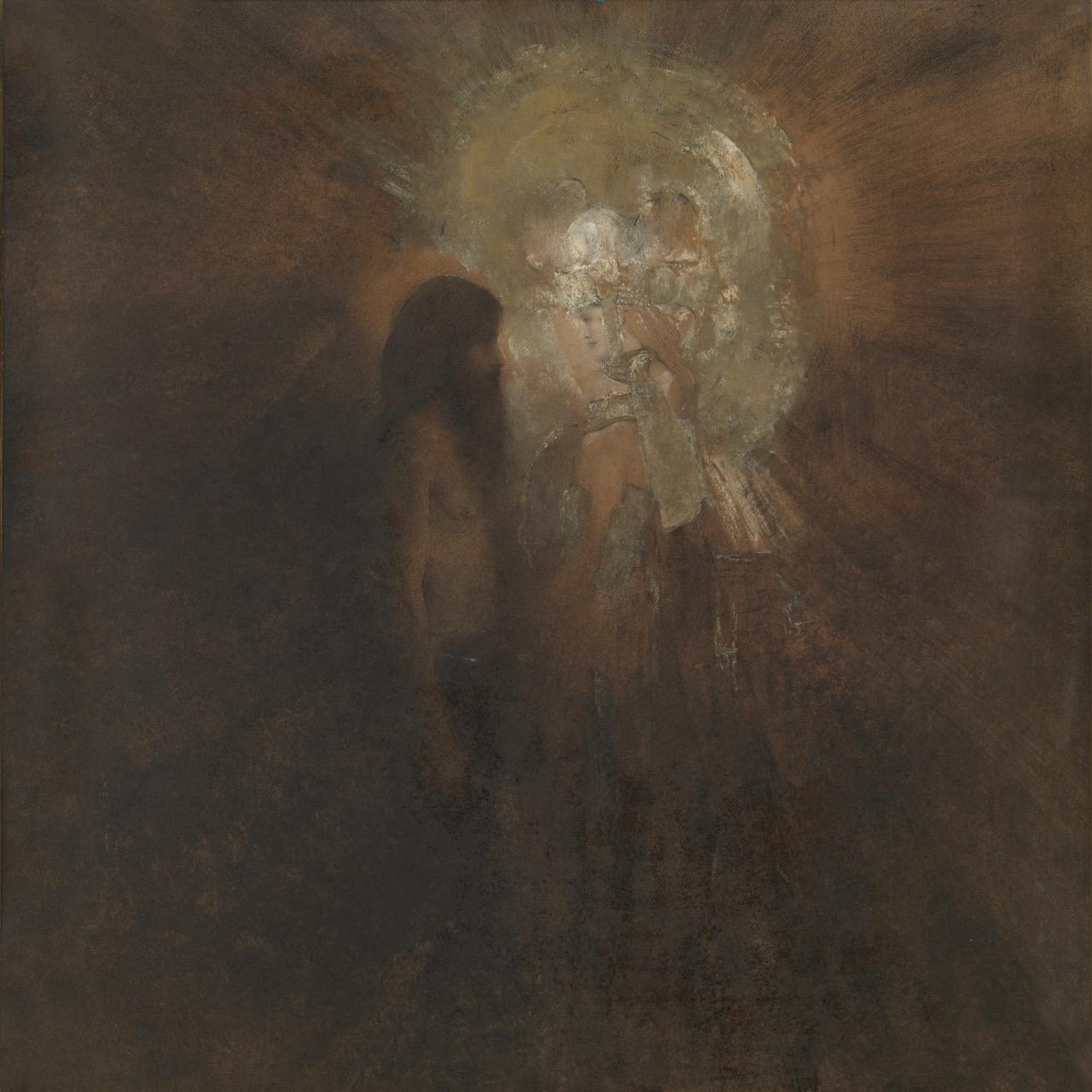
In 1883, Fernand Khnopff establishes himself as one the leading figures of the emerging symbolism with After Flaubert. The temptation of Saint Anthony. Shown in the first Salon des XX, nearby The temptation of Saint Anthony by Félicien Rops, this work shows a striking contrast between the two artists. Whereas Rops presents a physical and provocative vision of temptation, Khnopff offers a restrained, inward‑looking interpretation focused entirely on the ideal.
Although inspired by Flaubert’s text, Khnopff does not illustrate the narrative literally. Instead, he extracts a psychological tension and makes it tangible. Even the title shows a distance: it suggests an echo, a personal interpretation. The composition is structured around two hieratic figures, Saint Anthony and the Queen of Sheba, facing each other without touching. The empty space between them becomes the true focal point of the painting: a zone of doubt, hesitation, and suspended consciousness.
The queen of Sheba, haloed in light, appears not as a historical character but as a mental apparition, an image born of desire. Saint Anthony, frozen and withdrawn, regards her as if she were a part of himself. Temptation is no longer moral or physical, but internal: there is a a tension between the aspiration to purity and the fascination with an absolute ideal.
With this scene, Khnopff transforms temptation into a threshold, a moment of potential transformation. Like the Sphinx by Charles van der Stappen, created the same year, the feminine figure is here an enigma: she does not seduce the body, but she questions the mind. Without offering answers, she asks an essential question: what is the “self” if not this fragile space between desire and ideal?